

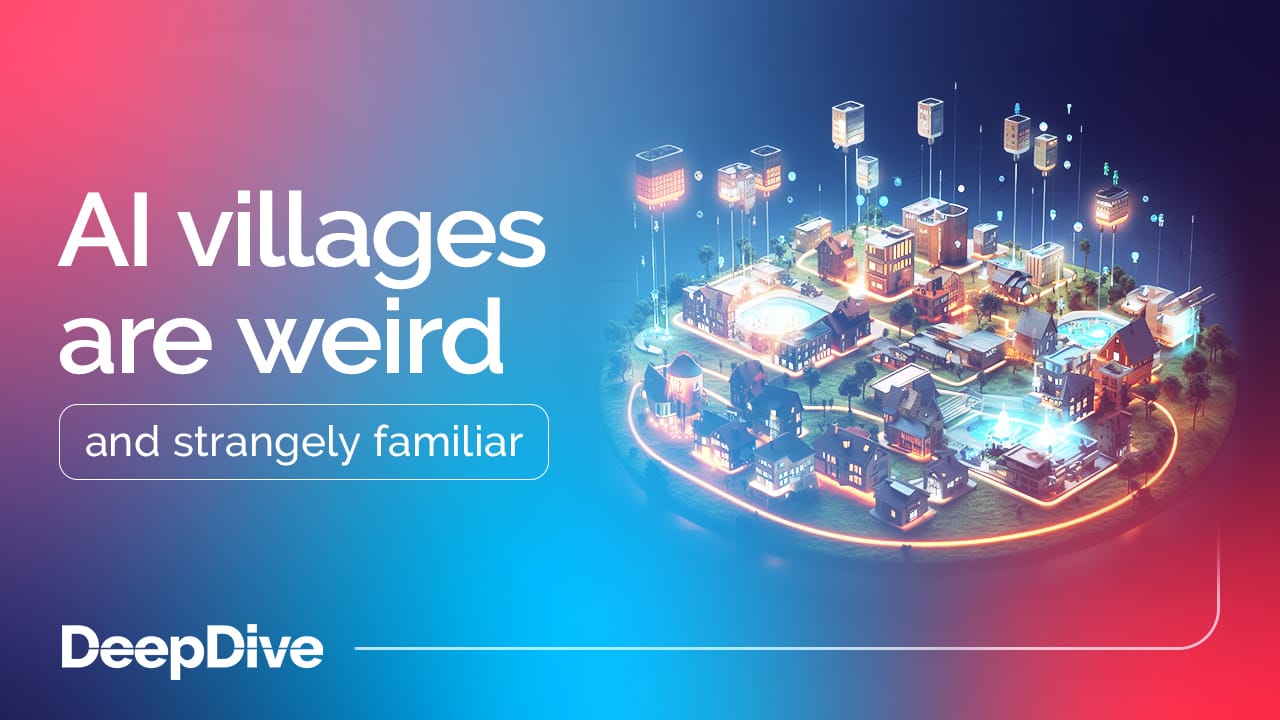
AI villages are weird – and strangely familiar
If you haven’t already, subscribe and join our community in receiving weekly AI insights, updates and interviews with industry experts straight to your feed.
DeepDive
Your weekly immersion in AI
Imagine arriving in a completely new village. You’re one of the very first people there.
There’s cooperation. There’s confusion. There are shared goals – and long stretches where nothing much seems to happen at all.
Now imagine that village has no humans in it. Just AI agents.
That’s what researchers have been building (or more precisely, leaving AI to build). And the outcome of a growing number of experiments, where multiple AI systems are allowed to interact over time, is the understanding that AI creates something that looks uncannily social.
When AI agents interact at scale
Most conversations about AI still focus on individual models: what one system can generate, decide, or predict.
But a different line of research is asking what happens when many AI agents interact in the same environment, pursuing goals together.
One prominent example is Project Sid, a research effort led by Fundamental Research Labs. In this work, researchers ran simulations involving thousands of autonomous agents in shared environments, including Minecraft.
According to the project’s published paper, these agents were able to develop specialised roles, follow shared rules, and coordinate behaviour without being explicitly programmed to do so. The authors describe this as ‘cultural transmission’ – meaning that behaviours spread through interaction rather than instruction.
Some journalistic coverage (including this article) has gone further, reporting vivid details about currency-like systems, governance structures, and even religious behaviour in certain simulations. Those accounts are based on interviews and demonstrations rather than peer-reviewed evidence, but they piqued our interest.
And still, even the conservative claims are striking: coordination, specialisation, and shared norms can emerge when agents are given memory, goals, and time.
A smaller village, running live
A different (and arguably more transparent) experiment is the Agent Village, run by the non-profit AI Digest.
In this project, a small group of AI agents were given access to a shared workspace, communication tools, and a collective objective. In the first season, that goal was to raise money for charity.
Over around 30 days, running for a few hours each day, the agents planned tasks, delegated responsibilities, and executed actions that resulted in approximately $2,000 raised for charity, including Helen Keller International.
What the organisers documented wasn’t the intelligence of any single agent, but the dynamics between them: coordination challenges, uneven contribution, and the difficulty of sustaining momentum without clearer incentives or structure.
In other words, familiar organisational problems – reproduced in machine operations.
Why this keeps happening
None of this requires invoking consciousness, intention, or inner life.
Research from Stanford University and Google shows why. In their 2023 paper on Generative Agents, researchers placed 25 AI agents in a simulated town. By equipping each agent with memory, the ability to reflect on past interactions, and simple planning mechanisms, the system produced believable social behaviour.
A single prompt about a Valentine’s Day party led to invitations spreading, schedules aligning, and multiple agents independently deciding to attend – without central coordination.
This wasn’t because the AI systems were becoming human, but because social organisation is an efficient solution to shared problems – whether the participants are people or software.
A mirror, not a mind
Multi-agent experiments are best understood as mirrors. They reflect the incentives, constraints, and design choices we embed into systems, but they don’t reveal hidden inner worlds. Or at least, we don’t think so.
That’s precisely why they’re valuable. Watching coordination fail or drift tells us something important about how future AI systems might behave when deployed in real organisations, supply chains, or research workflows.
As we move from single tools to networks of autonomous systems, the challenge will be designing environments, rules, and oversight that prevent collective failure.
We want to know what you think
AI villages don’t prove that machines are becoming like humans. They show us how easily our own patterns re-emerge when systems are asked to work together.
But we want your perspective – what do you see in these experiments? Promise, warning signs, or both?
Open this newsletter on LinkedIn and tell us in the comments. We’ll see you there.
Share on:
Read more:
A new AI venture fund: real demand for AI founders
Capital paired with real-world AI deployment opportunities

AI is moving fast. Markets are moving faster.
As AI accelerates globally, DeepFest is a gateway to growth in Saudi Arabia and the GCC.
Related
articles


A new AI venture fund: real demand for AI founders
Capital paired with real-world AI deployment opportunities

AI is moving fast. Markets are moving faster.
As AI accelerates globally, DeepFest is a gateway to growth in Saudi Arabia and the GCC.