Thousands of authors just published a book with no words
AI and artists collide again – so what’s next?

If you haven’t already, subscribe and join our community in receiving weekly AI insights, updates and interviews with industry experts straight to your feed.
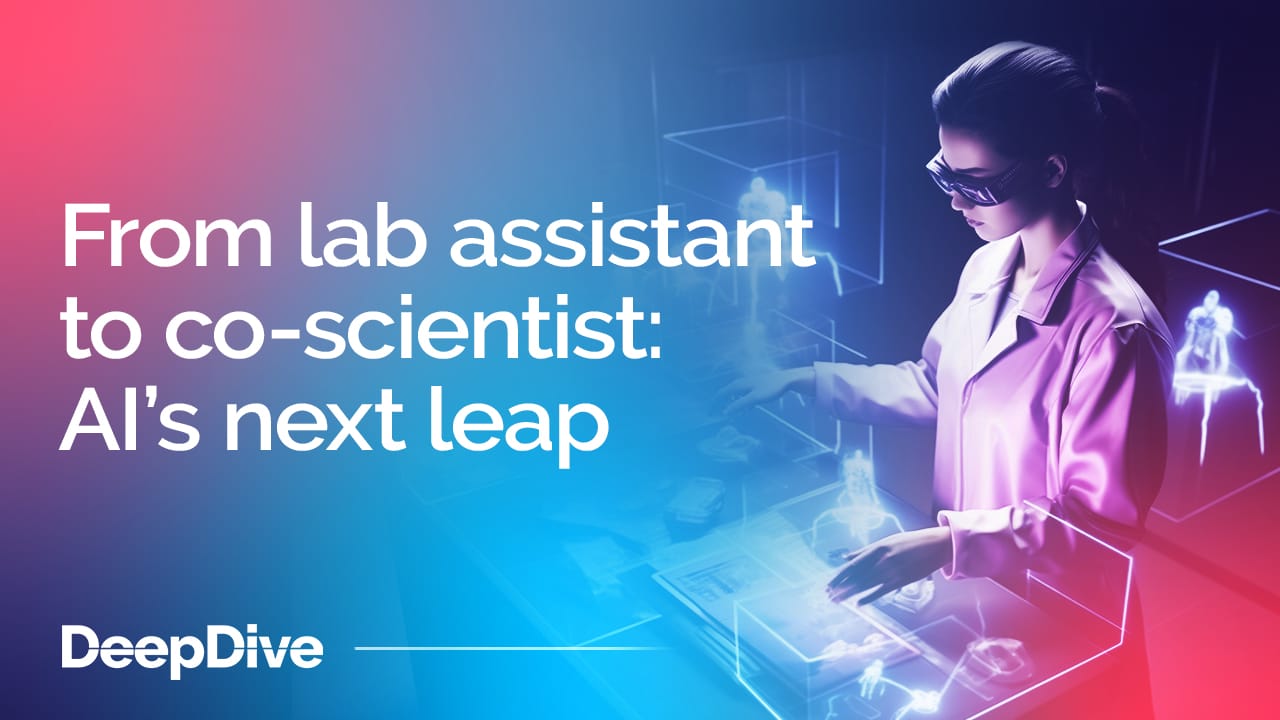
Today we’re looking at the latest developments in the journey of AI from lab assistant to co-scientist. Because AI is already established as a useful tool for researchers – helping search papers faster and analyse data sets; maybe even spot patterns you might’ve missed.
But that role is changing. In a handful of recent breakthroughs, AI is beginning to suggest what the work should be.
Let’s start in the lab.
Last year, researchers at Google introduced what they call an AI co-scientist – a system designed not just to assist, but to collaborate.
We’ve written about it in DeepDive before; in early experiments, it proposed drug repurposing candidates, suggested new biological targets, and (most intriguingly) generated a hypothesis about bacterial gene transfer that aligned with ongoing antimicrobial resistance research.
It’s worth taking a pause here. This doesn’t mean AI has ‘solved’ these problems. The hard part (testing, validating, proving) still sits firmly with human scientists.
But still, it points to a future in which AI continues to move upstream in the scientific process – from analysing results to generating ideas.
We think what makes this moment particularly interesting is that it isn’t isolated.
Around the same time, DeepMind introduced AlphaEvolve, a system designed for algorithmic discovery. Instead of just improving code, it identified new ways to solve mathematical problems – including a more efficient method for multiplying certain matrices, which is something that hadn’t changed in decades.
In materials science, a 2025 Nature paper showed that generative AI can design entirely new materials – producing candidates that are significantly more likely to be both novel and stable.
And in genomics, models like AlphaGenome are helping researchers understand how tiny changes in DNA might affect gene behaviour – effectively narrowing down which experiments are worth running.
These are different fields with different problems, but it’s the same pattern – AI is being used to explore what might exist.
Then things get even more interesting. Some of the latest systems don’t stop at generating ideas. They start to test them, learn from the results, and iterate – sometimes with minimal human intervention.
In 2025, researchers demonstrated AI-powered platforms that combine hypothesis generation with automated lab experiments, particularly in areas like enzyme engineering and materials discovery.
In practice, this means that instead of forming a hypothesis, running an experiment, and then waiting weeks or months for results, you could have a system that cycles through that loop rapidly – and refine its own approach as it goes.
In one case, an AI-guided system uncovered a previously unknown material structure after just a few dozen experimental rounds. That goes way beyond acceleration; it’s a different tempo of science.
If AI can generate ideas faster than we can, the role of the scientist has the potential to change – less time spent searching for possibilities, and more time spent deciding which ones are important. More judgement and interpretation, and maybe more responsibility.
It raises some big questions:
Because while AI can explore vast possibility spaces, it doesn’t understand consequences in the way humans do.
Most of these systems are research-stage, not everyday lab infrastructure. And human validation remains essential.
But as the trajectory continues, AI is moving from tool to collaborator; to something closer to a discovery partner. And the labs that figure out how to work with that may be the ones that define the next decade of science.
Join us at DeepFest from 31 August – 3 September 2026 to hear directly from the people shaping the future of technology and science.
AI and artists collide again – so what’s next?

AI and artists collide again – so what’s next?