

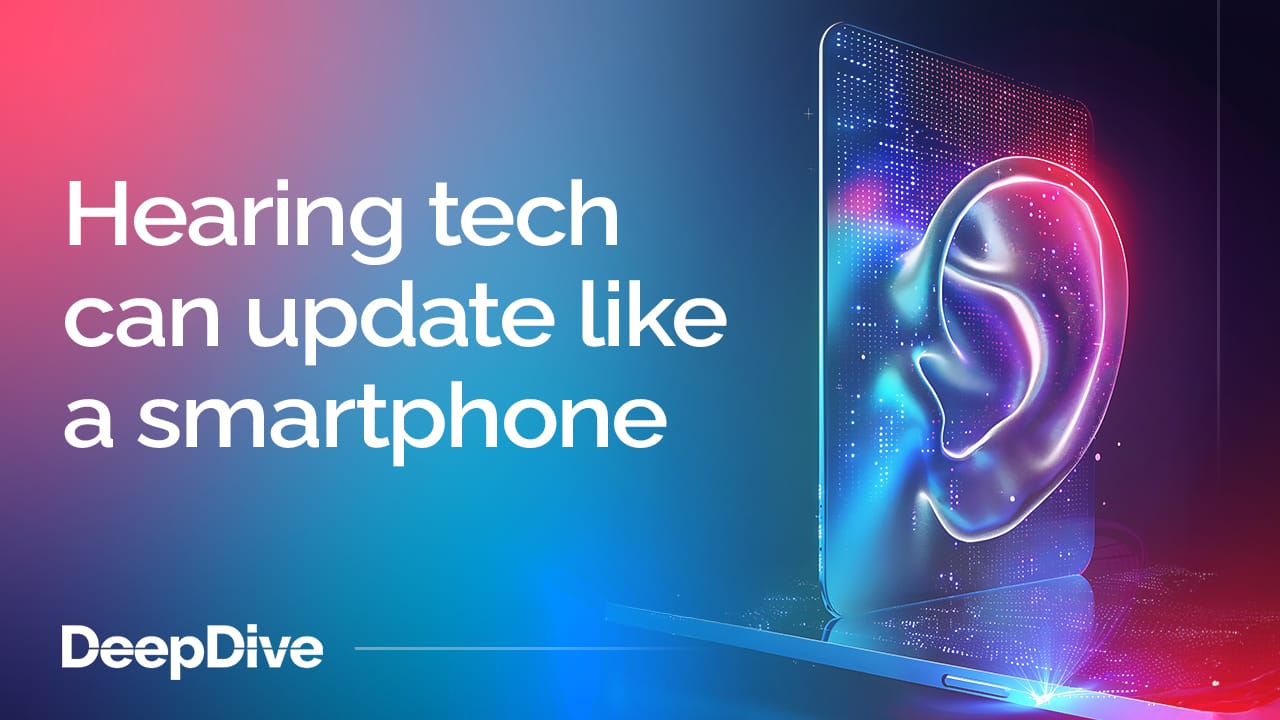
Hearing tech can update like a smartphone
If you haven’t already, subscribe and join our community in receiving weekly AI insights, updates and interviews with industry experts straight to your feed.
DeepDive
Your weekly immersion in AI
Imagine going to sleep with a cochlear implant that has already transformed your life – and waking up to find it… better. No surgery. No new hardware. Just a tiny firmware update that helps you follow fast conversation in a noisy café more easily than the day before.
Cochlear’s new Nucleus Nexa System promises exactly that; with a cochlear implant platform that doesn’t just sit inside the body, but learns, updates, and collaborates with you over decades. It’s edge AI literally under the skin.
What’s different about this implant?
Hearing loss is a global challenge. The World Health Organisation estimates that more than 1.5 billion people live with some degree of hearing loss today, including 430 million with disabling hearing loss. And by 2050, disabling hearing loss could affect over 700 million people worldwide.
But access to treatment remains worryingly low. A WHO analysis suggests only around 17% of people who would benefit from hearing aids actually use them. And in Australia, Cochlear notes that only 10-12% of adults who could benefit from a cochlear implant have one.
Cochlear implants work by bypassing damaged parts of the inner ear and sending electrical signals directly to the auditory nerve. But once implanted, their capabilities traditionally remain fixed for life. New signal processing techniques rarely reach the implant itself.
The Nucleus Nexa System has the potential to change that. According to Cochlear’s global announcements, it is the world’s first smart cochlear implant system, introducing:
- Upgradeable firmware inside the implant – the first of its kind. Able to update over time, it creates a smartphone-like evolution path decades after surgery.
- On-board memory that stores a user’s personalised MAPs, enabling a lost or replaced processor to automatically restore settings from the implant.
- A system-level algorithm called Dynamic Power Management, which interleaves power and data over an enhanced RF link to maximise battery efficiency and adapt to listening conditions.
In effect, this is an edge AI computer designed with a 40+ year lifetime in mind, with the ability to evolve while embedded in the body.
AI on the edge of the auditory nerve
The Nexa System uses machine learning at several layers. The external processor runs SCAN 2, an environmental classifier that categorises incoming sound into five scenes: Speech, Speech in Noise, Noise, Music, or Quiet. Those classifications feed a decision tree model that dynamically adjusts sound processing parameters for the environment.
And on top sits ForwardFocus, which uses two omnidirectional microphones to distinguish front-facing speech from noise at the sides and behind. Paired with SCAN 2, it can now activate automatically, which reduces the cognitive load that comes with constantly switching modes.
If you look at this tech from the perspective of an AI engineer, the demands are pretty extreme:
- Power: must run all day on tiny batteries for decades
- Latency: sound must be processed in near real time
- Safety: misclassification affects communication, not UX
- Privacy: processing happens on-device; only de-identified data enters Cochlear’s Real-World Evidence programme (more than 500,000 recipients)
This is edge AI meeting a biological interface, for commercial distribution. Which is quite a feat.
The potential impact of this is very real
The opportunity here is profound. A child receiving an implant today could see their device gain new capabilities many times across a lifetime, without another surgery.
For the industry, this shifts business models from one-off devices to long-term platforms that require software security, continual improvement, and ethical stewardship.
But as with any health tech development, it also brings up big questions:
- How do regulators evaluate over-the-air firmware updates to implants?
- How do we ensure access, when so few people globally receive the hearing care they need?
- How much control should users have over when algorithms take charge of their soundscape?
As edge AI moves deeper into the body (from implants to prosthetics to neural interfaces) we’ll need new templates for regulation and trust. This new system is an early testbed: interpretable models today, deeper neural architectures tomorrow, all delivered through an upgrade path that stretches across decades.
Register now for DeepFest 2026
We’ll be exploring the latest in AI-powered health tech at DeepFest 2026. Get your pass now to immerse yourself in the heart of future tech development, and add your voice to critical conversations about ethics and opportunities.
We can’t wait to see you there.
Share on:
Read more:
Predicting life’s first movements – one cell ahead
How geometric deep learning forecasts cell development

Related
articles

Predicting life’s first movements – one cell ahead
How geometric deep learning forecasts cell development