
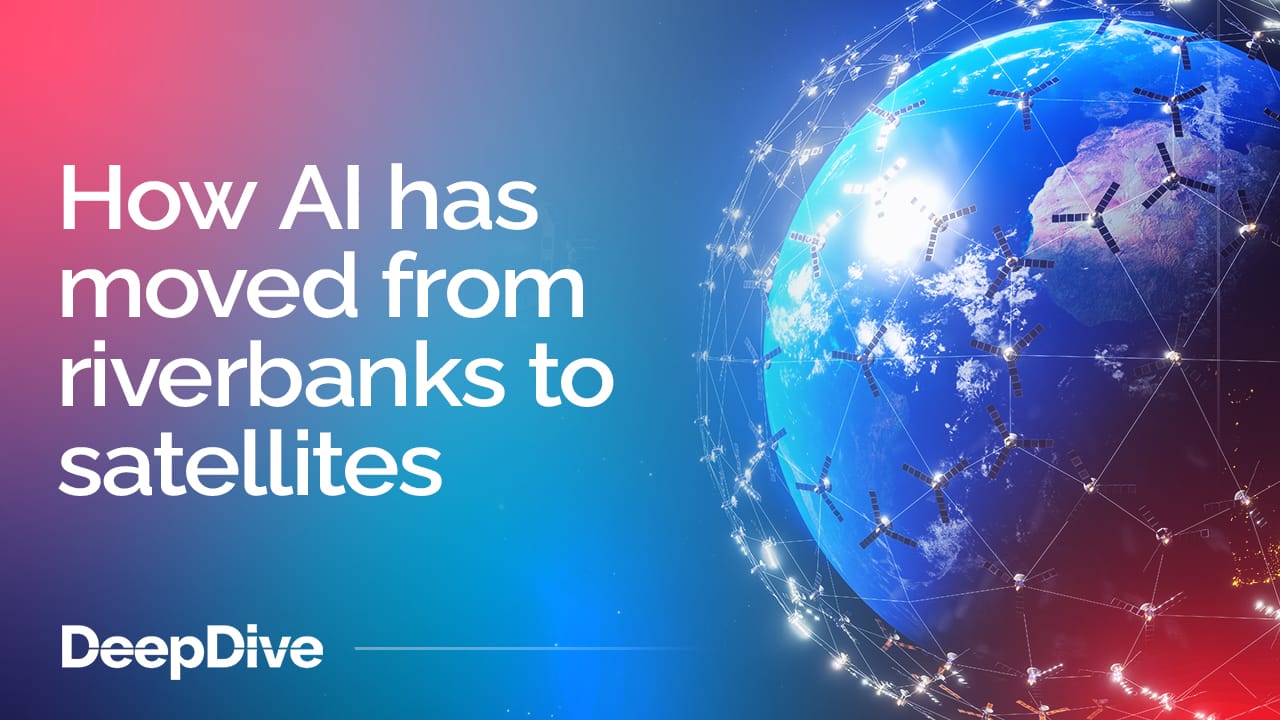
How AI has moved from riverbanks to satellites
If you haven’t already, subscribe and join our community in receiving weekly AI insights, updates and interviews with industry experts straight to your feed.
DeepDive
Your weekly immersion in AI
Trying to understand a deadly disease by hand (not in a lab or behind a computer screen) is hard work. In Senegal, researchers studying schistosomiasis have, for years, been standing waist-deep in rivers under intense heat, collecting freshwater snails one by one.
The parasitic disease affects more than 250 million people globally, primarily in low-income communities across sub-Saharan Africa, and can cause chronic pain, organ damage, developmental issues in children, and long-term health complications.
The challenge lies in finding where the risk is spreading in the first place. And that’s where AI is beginning to prove incredibly useful.
A small grant with enormous consequences
A new article from Stanford HAI tells the story of how a relatively modest seed grant helped launch an AI-powered disease monitoring platform that could dramatically expand how researchers track environmental health risks.
The original fieldwork was painstakingly manual. Researchers from Stanford spent years identifying disease-carrying snails and analysing the aquatic vegetation where they thrive. According to the team, some days involved ten straight hours of collecting and cataloguing samples in rivers and irrigation systems.
That work produced deep ecological knowledge and carefully labelled data.
Then came the AI collaboration.
With support from that Stanford HAI seed grant, computer vision researchers joined the project to train neural networks capable of recognising snail habitats and risky vegetation patterns from imagery. What began as a localised research effort evolved into a scalable disease-mapping platform powered by satellite data and machine learning.
As Stanford ecologist Giulio De Leo explained in the article:
“The work was absolutely necessary to discover these risks, but we can only do so much locally. We needed to replicate this on a much bigger scale.”
That’s one of AI’s superpowers – the most meaningful applications allow us to scale expertise.
AI as amplification, not replacement
The AI system couldn’t have existed without those years of human scientific labour first.
Because the algorithms didn’t independently discover the disease patterns. Human researchers did the difficult work of understanding the ecosystem, identifying correlations, and building the foundational dataset.
The AI then amplified that knowledge – allowing researchers to detect environmental risk factors across far larger geographic regions than would ever be possible manually.
This is a grounded and useful vision of AI in science – perhaps more so than the common narrative of fully autonomous discovery. We’re seeing that the real value of AI emerges when it augments domain expertise, rather than attempting to replace it entirely.
Can this be useful beyond just one disease?
Schistosomiasis is often described as a ‘disease of poverty’. It disproportionately affects communities with limited healthcare access, inadequate sanitation, and constrained public health infrastructure.
Which means technologies that can improve early detection and environmental monitoring could have a significant positive impact in regions that are traditionally under-resourced.
What we love most about this story is the way it shows how AI tools can help extend scientific visibility into places where large-scale monitoring would normally be prohibitively expensive or logistically difficult.
When you combine satellite imagery with machine learning, you create the possibility of continuously monitoring environmental conditions linked to disease transmission – not just for schistosomiasis, but potentially for other climate-sensitive or vector-borne diseases as well.
As climate change alters ecosystems and disease patterns worldwide, that capability may become more and more important.
The future of science looks more collaborative
There’s another lesson here too: breakthrough innovation doesn’t always begin with billion-dollar infrastructure.
In this case, Stanford researchers explicitly credited flexible seed funding for allowing them to explore an unconventional collaboration between ecology and AI research. Without that early experimentation, the platform might never have emerged at all.
Some of the most important AI breakthroughs over the next decade could come from better interdisciplinary partnerships. And the future of scientific discovery could depend on AI helping experts scale insights and ask better questions faster.
What should AI help us see next?
As AI systems become more capable of interpreting complex environmental and biological data, where could human-AI collaboration have the greatest impact next?
Climate resilience? Food security? Pandemic prevention? Biodiversity protection?
Open this newsletter on LinkedIn and tell us what you think.