
Governance just got cool again (and we’re into it)
The most ambitious markets are treating governance as an opportunity

If you haven’t already, subscribe and join our community in receiving weekly tech insights, updates, and interviews with industry experts straight to your inbox.
Expand your perspective with insights and inspiration from the global LEAP community – in your inbox every week.
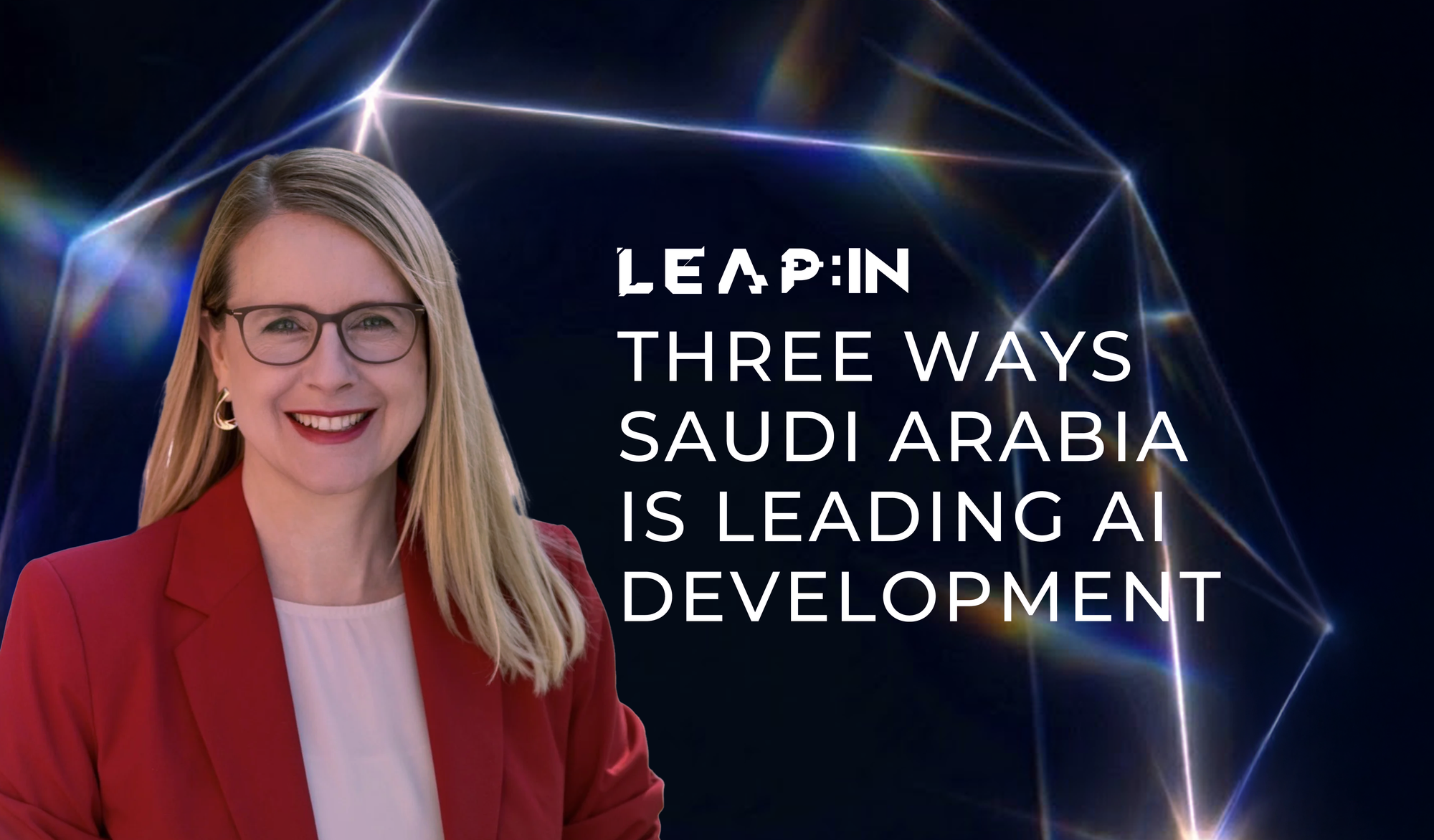
What Schramboeck said:
“Companies that want to do business here must be fast and innovative. Seize the moment, be brave and professional. The possibilities here are many, you just have to take advantage of them."
Schramboeck was talking about Saudi Arabia. And we remembered her words this week because recent developments in AI here have highlighted what Saudi Arabia is doing differently: creating systems to make sure different pieces of AI development can work together.
Infrastructure, platforms, and national strategy are aligning in a way that turns ambition into execution.
Here are three ways that’s playing out.
Saudi Aramco is extending its role beyond energy into AI and advanced computing.
AI systems rely on physical infrastructure: data centres, electricity, cooling, and land. These are the conditions that allow models to train and operate at scale.
By combining energy resources with investment in computing and digital systems, Saudi Arabia is developing an environment where large-scale AI workloads can operate reliably.
Because AI isn’t only software – it’s also infrastructure.
The SUSTAIN platform, in development with the World Economic Forum and Bain & Company, applies AI to partnership formation.
It creates a structured system:
And the result is faster, safer collaboration, and clearer pathways from idea to execution. It has the potential to drive significant scale – up to $20 billion in partnerships within Saudi Arabia by 2030, and up to $100 billion across the MENA region.
This is AI operating as a coordination layer – connecting all the elements that make a sustainability project actually work.
These efforts connect through Vision 2030 and the National Sustainable Development Blueprint.
The approach brings alignment across:
So AI becomes part of how systems operate across industries and initiatives. In turn, that creates continuity between ambition and delivery – giving all partners and funds a shared framework to work with.
Tools are one thing – but infrastructure and platforms, along with policy, determine how far those tools can scale. And even more importantly, how usefully they can scale.
Connecting the right players quickly can accelerate outcomes across sectors. AI is a powerful engine, but it can’t operate without a connected, collaborative network.
And in Saudi Arabia, that network is being built right now.
At LEAP, concepts like these become real to you. You see how they really work – and experience the impact connected networks can have on your own business.
Meet the people building AI infrastructure and the people developing the most valuable new tools.
We’ll see you there: 31 August – 3 September 2026 in Riyadh.
Have an idea for a topic you'd like us to cover? We're eager to hear it. Drop us a message and share your thoughts.
Catch you next week,
The LEAP Team
The most ambitious markets are treating governance as an opportunity
Two companies arrived at LEAP with very different ambitions. Both left on a larger trajectory.

The internet stopped being a place we visit – and became the environment we live inside.
The most ambitious markets are treating governance as an opportunity
Two companies arrived at LEAP with very different ambitions. Both left on a larger trajectory.

The internet stopped being a place we visit – and became the environment we live inside.