

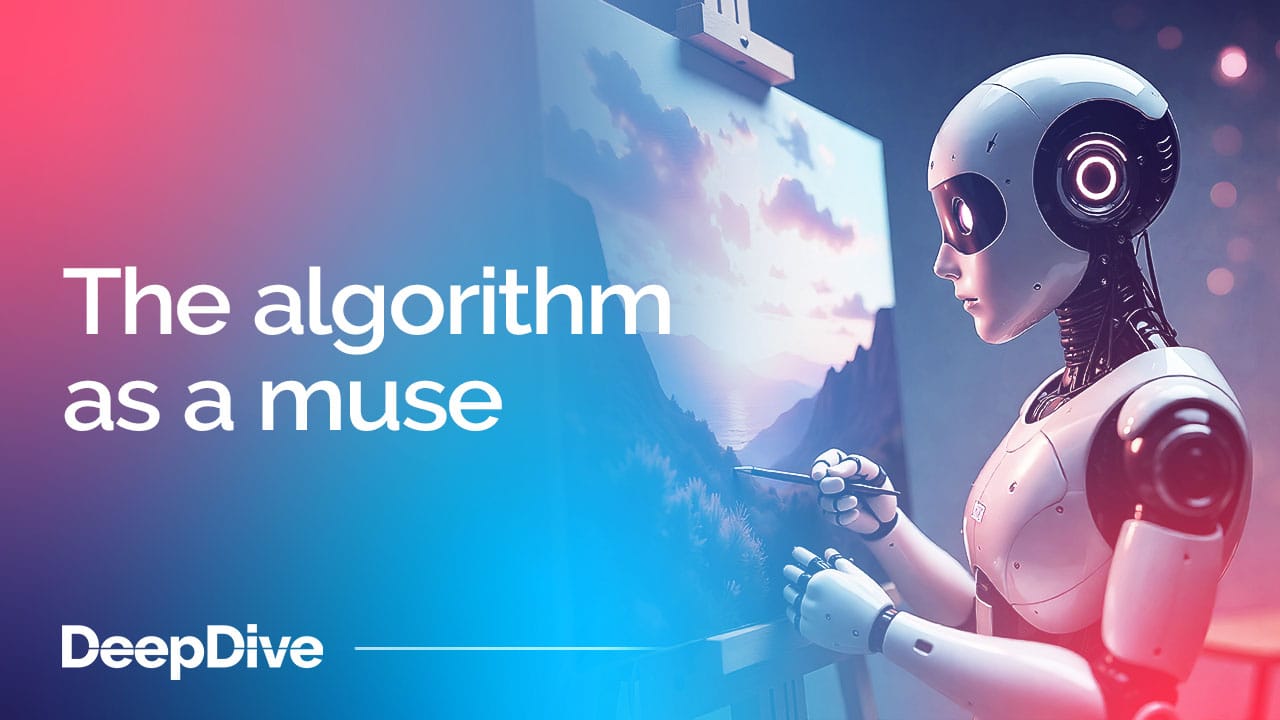
The algorithm as a muse
If you haven’t already, subscribe and join our community in receiving weekly AI insights, updates and interviews with industry experts straight to your feed.
DeepDive
Your weekly immersion in AI
If you could go back in time and peer into the studio of a Renaissance artist, that artist would not be alone.
An apprentice might be grinding pigments in the corner while another sketches backgrounds. A master painter would add the final touches. The artwork bears one signature – but many hands shaped it.
Now replace the apprentices with algorithms.
Creativity has rarely been a solitary act. It has been iterative, collaborative, shaped by tools and tradition. Today, generative AI has entered the studio – and its presence is more provocative than any brush or chisel or assistant. It’s a system capable of producing work in seconds.
But is AI creative?
What do we mean by ‘creativity’?
In psychology, creativity is typically understood as producing something both novel and useful – as explored in The Standard Definition of Creativity.
Margaret Boden, a pioneer in computational creativity, went further. In her influential 1998 paper Creativity and Artificial Intelligence she proposed three types of creativity:
- Combinational creativity – new combinations of familiar ideas
- Exploratory creativity – exploring structured conceptual spaces
- Transformational creativity – changing the rules of the space itself
Mapping this framework onto GenAI is an interesting thought experiment. LLMs don’t ‘feel’ inspiration – but they’re extraordinarily powerful at recombining patterns and exploring vast conceptual spaces. In Boden’s terms, they excel at combinational and exploratory creativity.
Transformational creativity? That one’s more contested.
What does the evidence say?
Beyond philosophy, empirical research is starting to quantify AI’s impact on human creativity.
One 2024 study published in PNAS Nexus found that generative AI tools significantly increased participants’ creative productivity – producing more ideas and, in some cases, higher-rated outputs.
That being said, the study also observed a trade-off: outputs became more similar to one another over time.
So more ideas, but less diversity.
Another review surveying advances and challenges in AI creativity similarly highlights this tension: generative systems can produce convincing art, music and text, but questions remain around originality, authorship, and conceptual depth.
And workplace evidence suggests the impact is nuanced. As reported by MIT Sloan, researchers have found that GenAI can enhance creative performance – but only when users engage reflectively, rather than passively accepting suggestions.
AI, then, doesn’t replace creative thinking. But it does change how we think creatively.
Is originality just remixing?
There’s another possibility here.
If creativity has always involved recombination (borrowing, remixing, transforming), then AI may not be as alien to the creative process as we assume.
Human artists draw on influences and cultural memory. Generative models are trained on a vast body of human-created data. Both systems operate within constraints. Both generate novelty from patterns.
Maybe the difference lies not in the mechanism – but in intention, lived experience, and meaning.
We recently read a feature in Nature, which explores this debate. It highlights how researchers disagree on whether AI’s outputs qualify as ‘true’ creativity or sophisticated pattern completion.
Some argue that without consciousness or intrinsic motivation, AI can’t genuinely create. Others suggest that creativity may not require subjective experience at all – only novelty within a system.
We don’t think that tension is likely to resolve any time soon.
How humans respond to AI art
Even when AI outputs rival human ones technically, perception is still incredibly important.
Research published in the journal Frontiers in Psychology shows that people tend to value human-made art more highly than AI-generated art – even when quality is comparable.
We can relate to that. If you read a novel and then find out it was written by AI and not a human author, you’re probably less likely to rate the novel.
But…why?
Because we attach meaning to authorship. We respond to perceived intention, effort, and narrative.
A painting isn’t just pigment on canvas; it’s the story of the painter.
And this could be a real shift already underway. As generative AI becomes ubiquitous, the value of explicitly human perspective may increase rather than diminish.
The future of creativity
Where does this leave us?
AI systems can recombine at scale. They can explore design spaces faster than any individual human. They can lower barriers to creation, enabling more people to experiment with art, music, and storytelling.
That’s exciting.
But they also risk homogenising outputs. They challenge traditional notions of authorship, and they force us to articulate what we actually value in creative work.
Maybe instead of asking whether AI can really be creative, we should start asking what kind of creativity we want to cultivate in the age of AI.
Do we value speed and scale? Or singular vision and human narrative? Can we design systems that amplify diversity rather than compress it?
The Renaissance workshop didn’t diminish the master artist. It expanded what was possible.
The algorithm may not replace the muse. But there’s a good chance it’ll change the studio.
We want to know what you think
Open this newsletter on LinkedIn and share your perspective: has AI changed how you define creativity?
Share on:
Read more:

A new AI venture fund: real demand for AI founders
Capital paired with real-world AI deployment opportunities
Related
articles



A new AI venture fund: real demand for AI founders
Capital paired with real-world AI deployment opportunities