

Why CoLAB works: how global brands use events to enter new markets
Learn how global brands use events to enter new markets. Build trust and accelerate relevance through CoLAB collaborations at LEAP.

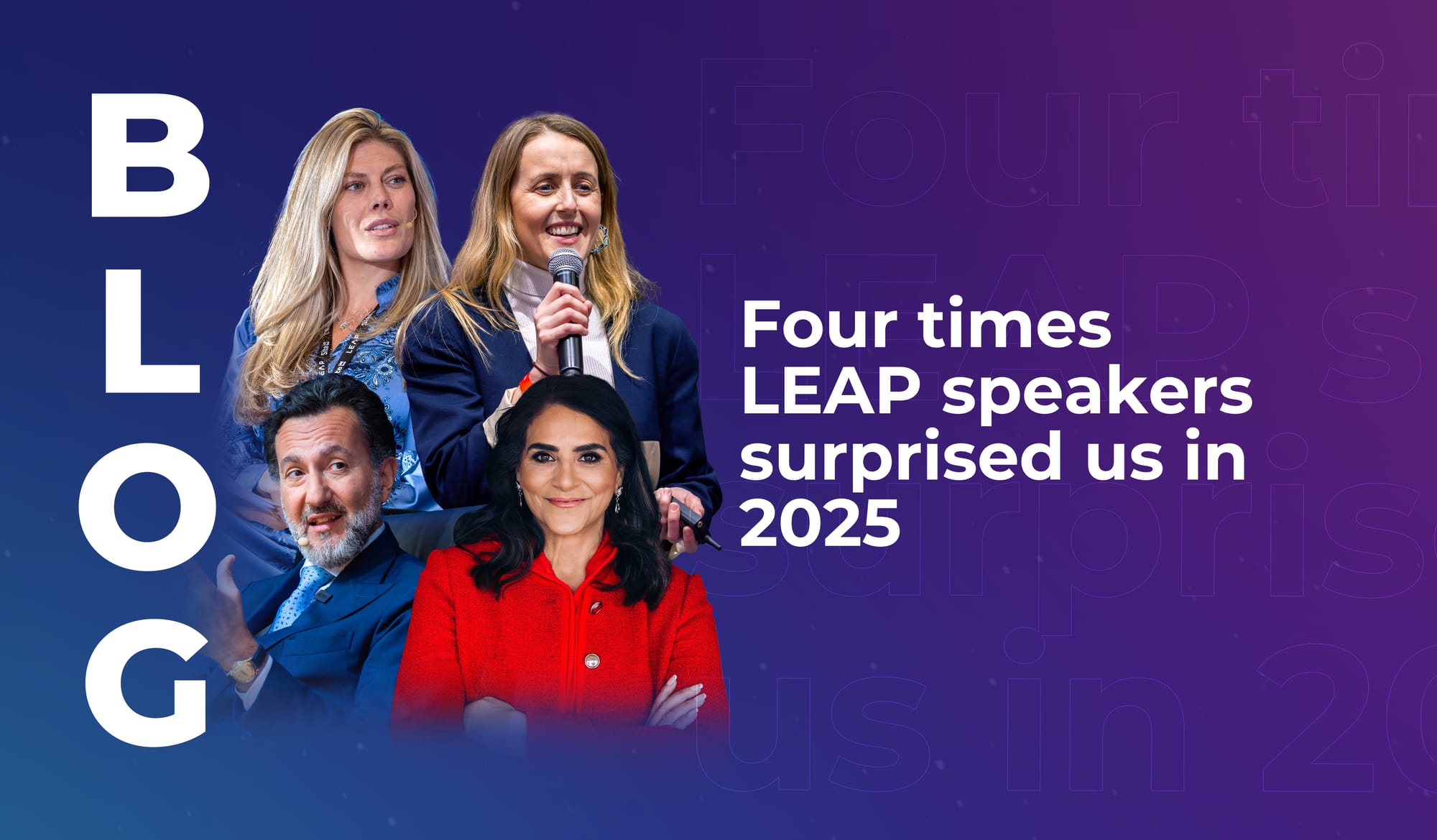
The big announcements each year at LEAP are always exciting. But sometimes the moments that stay with us are less headline-worthy; a turn in a conversation that makes ideas land sideways, and changes how you see the people who’re developing technologies for the future.
So today, we’re sharing four moments like that, from conversations with LEAP speakers throughout 2025. Each one challenged an assumption: about tech, about judgement, about leadership, and about the myth of ‘arrival’.
And when we put them together like this, they remind us that innovation is like a tide – it comes in, it goes out, and as it moves it changes the shoreline in ways you can only really understand when you step back
We expected Stephanie Singer (Creative Director at BitterSuite) to champion technology in the arts – she works at the deep intersection of sensory experience and innovation.
But when we asked her what she’d say to someone who was convinced that layers of technology within a musical experience increase disconnection (rather than connection), she said:
“I’d say – I agree! Technology can absolutely create disconnection if it’s used thoughtlessly. But tech isn’t just one thing; it’s a palette of colours, a set of tools we can choose from. What matters is how and why we use it.”
Especially in a year saturated with GenAI positivity, it was a refreshing reminder that the point isn’t to always use more tech, but to use it well – with intention and sensitivity.
Investors often talk about instant connection, or ‘founder-market fit’. Elsa Hyland (Angel Investor and Startup Advisor) turned that on its head:
“One of my best investments (or rather, a founder I deeply believe in) actually started on the opposite note. We didn’t really click in our first interaction and I thought he was slightly arrogant. But he was persistent, and over time we built a great relationship…It taught me an important lesson about overcoming biases and looking beyond surface impressions to recognise true potential.”
Then she added:
“To combat this, I focus on building longer-term relationships with founders to observe their growth and execution over time. The magic often lies in staying curious about people and things that you normally would look beyond.”
For investors who aim to meet their next match at LEAP 2026, it’s a very useful note. First meetings matter less than what happens next – the steady compounding of trust and consistency over time.
We asked Maha Abouelenein (Founder and CEO at Digital and Savvy) a question: Should every founder or CEO build a personal brand?
We expected nuance. Caveats. A gentle ‘it depends’, perhaps.
But her actual response was:
“Absolutely – 100% yes. Every founder or CEO should build a personal brand, but it needs to be done with strategy and intention. It's not about becoming a ‘celebrity CEO’ – it's about using your personal brand to drive trust, credibility, and influence.”
No doubt at all – clear certainty that in an era when investors back people as much as products, visibility is a new kind of operational necessity.
There’s ambition; then there are people like Rodi Basso (CEO at E1 Series).
We asked if he ever reaches a point where he thinks, this is it – the innovation is done.
His reply:
“The day when I will say ‘this is it, it can’t be improved’ will be the day to retire. Technology and business innovation is my blood.”
It stayed with us, because we recognise this quality in lots of tech innovators, and even in ourselves; in tech, improvement becomes less of a journey, and more of an identity.
Across these conversations we recognised a shared intentionality. Each moment represents a deliberate choice to make bold decisions, and to make sure those decisions are backed by a sense of purpose.
And at the end of the day, innovation is a set of choices (sometimes they’re careful ones, and sometimes they’re courageous ones) that compound into something new.
Learn how global brands use events to enter new markets. Build trust and accelerate relevance through CoLAB collaborations at LEAP.

At global tech events, your brand isn’t competing for space – it’s competing for memory. Memory is built through participation, so the brand collaboration opportunities at LEAP are designed for it.

For investors at LEAP, experience is the first stage of due diligence – and has more impact than a pitch deck. Find out how the Tech Arena fast-tracks investor conversations.

Learn how global brands use events to enter new markets. Build trust and accelerate relevance through CoLAB collaborations at LEAP.

At global tech events, your brand isn’t competing for space – it’s competing for memory. Memory is built through participation, so the brand collaboration opportunities at LEAP are designed for it.

For investors at LEAP, experience is the first stage of due diligence – and has more impact than a pitch deck. Find out how the Tech Arena fast-tracks investor conversations.