

The startup turning education into an investable asset class
EduFi Founder Aleena Nadeem explains how winning LEAP Rocket Fuel accelerated regional growth and why education finance is emerging as an investable asset class.

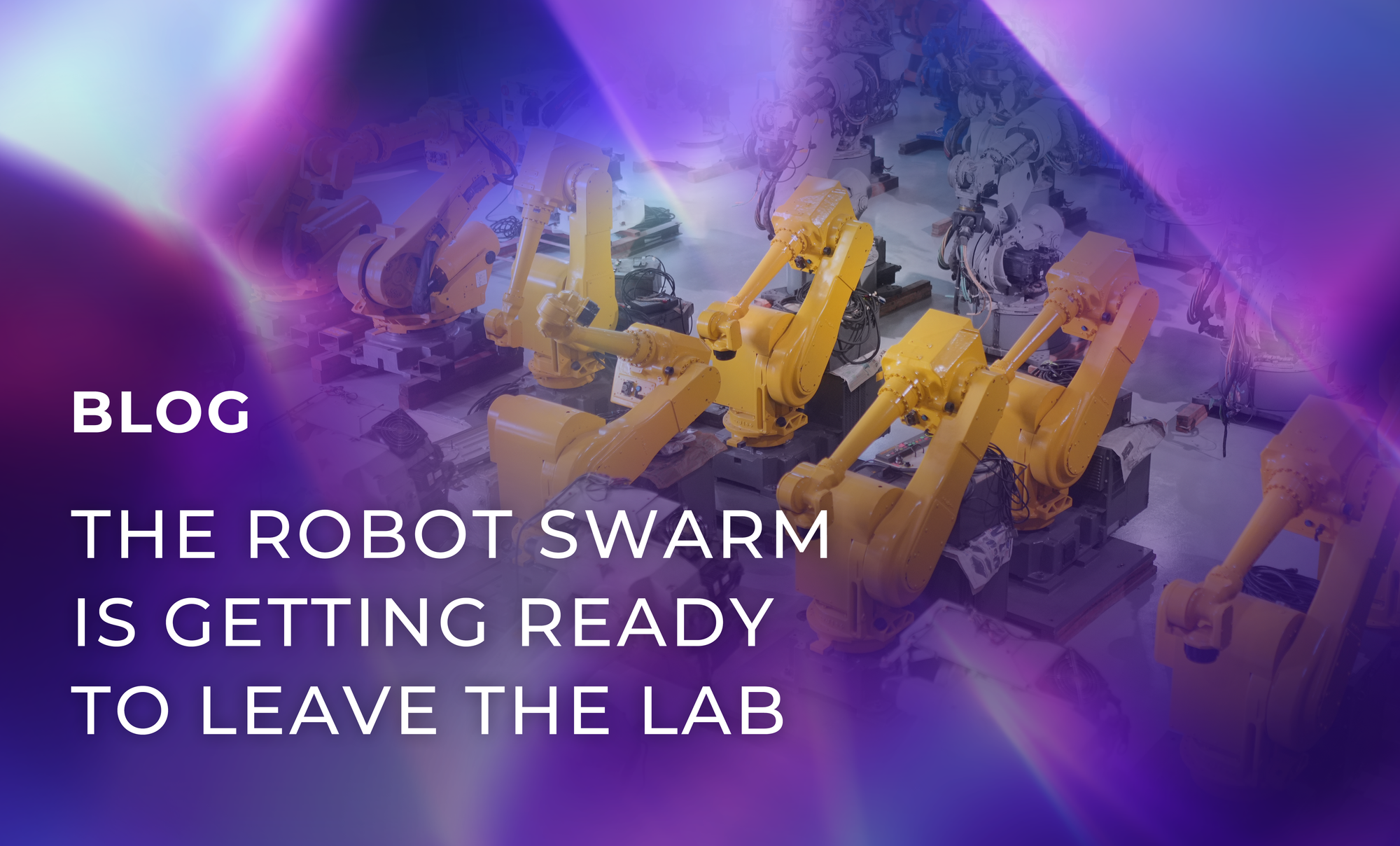
The field of swarm robotics has been mostly confined to the lab for a long time, with promises of fleets of machines that can coordinate like colonies in nature. New research suggests the route into the real world is becoming clearer – one stubborn engineering problem at a time.
Picture a disaster zone after an earthquake. Instead of sending one robot into a damaged building, responders release dozens. Those robots spread through corridors, exchange information, map safe routes and keep searching when individual machines fail.
That, in a nutshell, is where the value of swarm robotics lies: in the power of groups of robots coordinating their behaviour, often through local decisions rather than instructions from a single controller. Researchers have been exploring this idea for decades. But the real challenge begins when the robots leave the laboratory.
A 2025 perspective in Frontiers in Robotics and AI offers a useful diagnosis. Swarm research has frequently relied on simulations or compact experimental robots with limited sensors, computing power and movement capabilities. Physical experiments also become more expensive and time-consuming as swarm size increases.
This creates what roboticists call the reality gap: an algorithm can perform beautifully inside a simulation, then encounter friction, noisy sensors, patchy wireless connections and unexpected obstacles in the physical world.
There’s another gap too. Software developed successfully for one robot platform can lose performance when transferred to another. The researchers in that Frontiers article call this the deployment gap.
For a swarm, every small weakness can multiply. One unreliable connection is inconvenient, but across a large swarm, reliable communication becomes a systems problem.
Part of the answer could be better experimental hardware. Published in HardwareX in 2026, Mercator is a modular mobile robot developed specifically for contemporary swarm research. Its capabilities include object and people recognition, obstacle detection, tracking and local decentralised communication, alongside support for modern robotics software through ROS.
The Mercator-Lite version also has an estimated build cost of around €850 per robot, according to the paper.
That makes the platform interesting because researchers can test collective behaviour using sensing and computing capabilities closer to those found elsewhere in modern mobile robotics. And experiments can become richer too – navigation, mapping and computer vision can sit alongside classic swarm tasks built around movement and local interaction.
A second project takes a different route. Researchers at Nanyang Technological University developed AirSwarm, a system designed to coordinate commercially available drones such as the DJI Tello. The project combines ROS software, visual localisation and hierarchical control, using off-the-shelf hardware rather than a bespoke fleet.
In physical tests using three Tello EDU drones, the team reported absolute pose errors of 2.34 cm, 2.55 cm and 3.87 cm while the drones flew coordinated trajectories.
During navigation, AirSwarm used onboard camera-based localisation rather than an external motion-capture system.
And in the authors' evaluation, AirSwarm recorded a 99% localisation success rate, compared with 3% for CCM-SLAM and 31% for CP-SLAM.
Those are encouraging numbers – although the limits are just as important. The current implementation is limited to coordinating three Tello drones simultaneously by the compute capacity of its NVIDIA Jetson AGX Orin architecture. Its visual localisation also becomes less effective in spaces with few distinctive visual features or lots of repetitive patterns.
Three drones don’t constitute a large-scale swarm. But the experiment shows that coordinated multi-drone research can be carried out using commercially available hardware, rather than relying entirely on expensive, purpose-built systems – and that’s important.
The algorithms are moving alongside the hardware. A 2025 paper introduced AMET, an optimisation technique for multi-robot exploration. In simulated environments, it achieved higher exploration coverage than the four comparison methods tested by the researchers.
In one simple-map experiment, AMET reached 96% coverage, compared with 89% for the next-best method reported in that test.
The difference in methods is important. These were simulated experiments, so translating those results into physical multi-robot systems is a whole other test.
That gap between software performance and real-world reliability runs through almost every conversation about swarm robotics. The software can run ahead, but physics will eventually ask for proof.
For swarm robotics, the next breakthrough may arrive through accumulation: better platforms, cheaper components, stronger localisation, more reliable communications and experiments that increasingly resemble the environments robots will eventually enter.
Researchers also point to regulation, transparency and human trust as part of that journey, particularly for aerial swarms. Real-world systems will need to behave reliably while giving people enough visibility into how collective decisions are being made.
That’s a different challenge from getting ten robots to move together in a lab.
Swarm robotics is beginning to acquire better tools for testing its biggest ideas in the physical world. The distance between a compelling demonstration and a dependable system is still substantial, but researchers can now probe that distance with more capable hardware and increasingly sophisticated software.
Which means that the laboratory door is beginning to open – even if very slowly. And what happens on the other side will tell us how far the swarm can really travel.
EduFi Founder Aleena Nadeem explains how winning LEAP Rocket Fuel accelerated regional growth and why education finance is emerging as an investable asset class.

Discover how LEAP Rocket Fuel 2025 helped deep tech startup Brelyon accelerate its growth, win new customers, expand into Saudi Arabia and scale its headset-free immersive display technology.

It’s not every day that you land on your next big idea while you’re trekking on horseback through Mongolia. But that’s exactly what happened for Jack Withinshaw (Founder and CEO at Airspeeder). Together with co-founder Matthew Pearson, Withinshaw is pushing the boundaries of what’s possible

EduFi Founder Aleena Nadeem explains how winning LEAP Rocket Fuel accelerated regional growth and why education finance is emerging as an investable asset class.

Discover how LEAP Rocket Fuel 2025 helped deep tech startup Brelyon accelerate its growth, win new customers, expand into Saudi Arabia and scale its headset-free immersive display technology.

It’s not every day that you land on your next big idea while you’re trekking on horseback through Mongolia. But that’s exactly what happened for Jack Withinshaw (Founder and CEO at Airspeeder). Together with co-founder Matthew Pearson, Withinshaw is pushing the boundaries of what’s possible