


What if robots don’t need to look like us?
Be inspired by the global LEAP community – in your inbox every week.
This week we’re quoting…
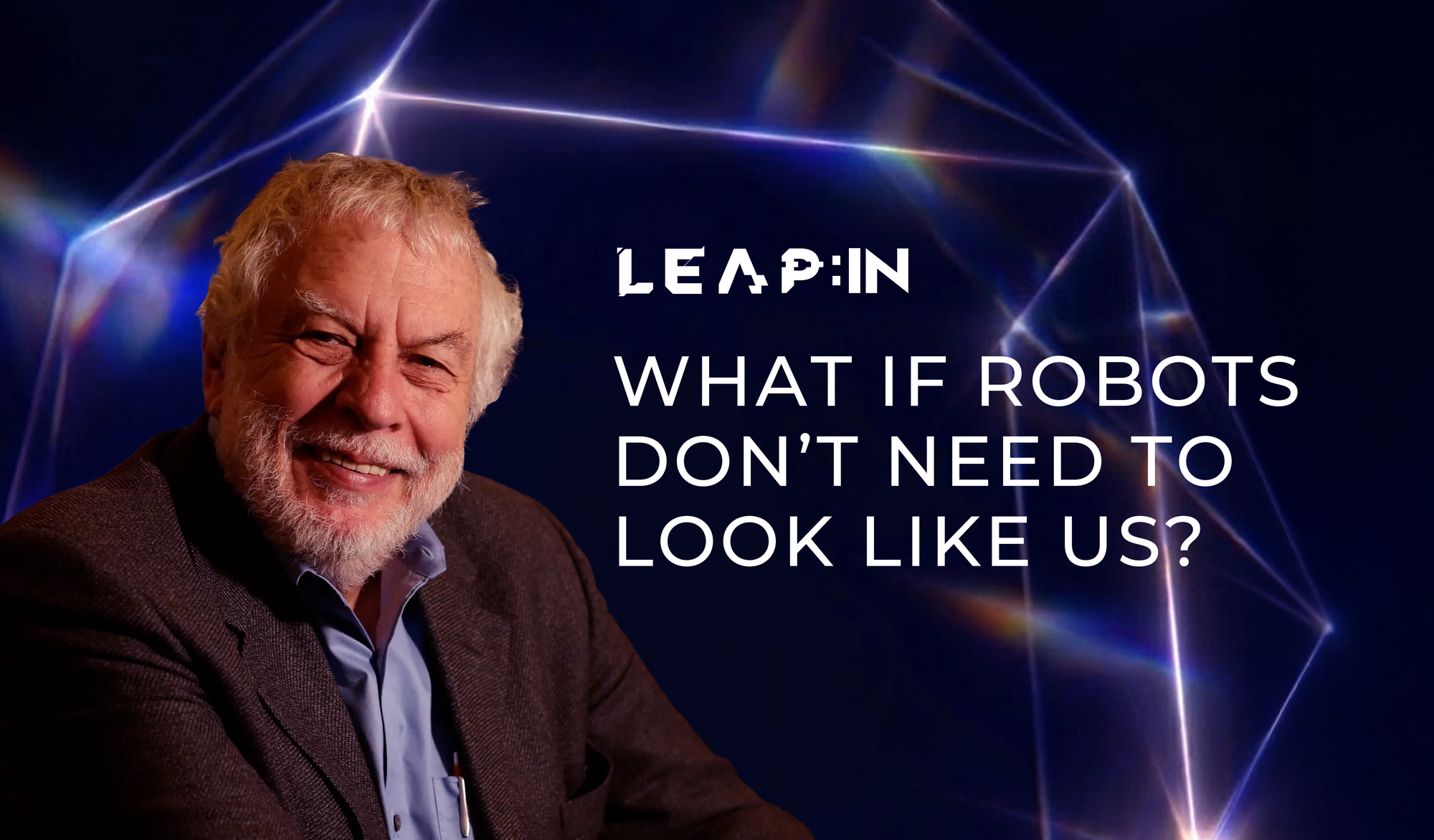
Nolan Bushnell (Tech Pioneer, Engineer and Scientist)
What Nolan said:
“I just want the future to happen faster. I can't imagine the future without robots.”
Is that opening quote familiar?
If you recognise that quote, we’re going to take that to mean you’re a long-time reader – because we used the same words to open a different LEAP newsletter, over a year ago.
In that newsletter, we asked a question that people have been asking, in various forms, for a very long time: why do we want humanoid robots anyway?
We explored our fascination with building machines in our own image. We talked about WABOT-1, the pioneering humanoid unveiled at Waseda University in 1973, and traced that lineage through to a new generation of robots designed to walk through our workplaces and use our tools.
There is a practical argument for giving robots bodies like ours. We have spent centuries building a world around human dimensions. Our stairs are made for legs, our doors are made for hands; we designed vehicles, kitchens, tools and factories based on the assumption that humans would use them.
But lately, we’ve been thinking about Nolan’s quote again. Because if the future really is full of robots, there’s another possibility worth considering:
That most of them won’t look anything like us.
Take the robot out of our world
Imagine sending a robot somewhere that was never designed for humans. Maybe into narrow pipes, or through the rubble of a collapsed building. Across hundreds of hectares of farmland, or along the ocean floor; into an environment where there are no door handles to grip and no stairs to climb.
The logic of the humanoid body doesn’t really work there.
Instead, engineers can begin with the environment itself.
- What does the robot need to reach?
- What must it withstand?
- How should it move?
- Does it need a skeleton at all?
- Does it need to work alone?
Questions like these are producing some of the strangest machines in robotics – and researchers are increasingly turning to an engineer with several billion years more experience than we have:
Nature.
Evolution has already filled the sketchbook
If you spend enough time reading soft robotics research you’ll encounter a wonderfully unconventional cast of design consultants.
There are octopuses, whose arms bend and twist without rigid bones. Insects that move rapidly through tiny spaces, and animals whose bodies combine hard skeletons with muscles, tendons and flexible tissue. Researchers are even looking at the microscopic machinery operating inside biological cells.
And this isn't purely speculative. Recent research gives us a glimpse of what happens when engineers start exploring these ideas:
- In 2025, researchers demonstrated a cockroach-inspired microrobot just 2 cm long that reached 4.8 body lengths per second and remained functional after being stepped on.
- Another team developed a robotic hand combining soft pneumatic fingers with a tactile palm. In one experiment, using palm feedback increased its successful pickups from 65% to 100% across 20 trials.
- Researchers also built a soft-hybrid quadruped inspired partly by the walking trajectories of animals such as horses, and demonstrated it across sand, soil and rock.
- And swarm robotics researchers are tackling a different problem: how to make multiple machines work together. In the 2025 AirSwarm project, three commercially available drones flew coordinated trajectories using onboard camera-based localisation rather than external motion capture.
These are still research systems, and their individual results come with experimental boundaries. But they illustrate how much wider the robotic design space can become once the human body stops being the default.
Those researchers aren’t trying to populate the world with mechanical cockroaches and synthetic octopuses. Bio-inspired robotics is more interesting than imitation. Researchers can study a biological solution (think resilience, flexibility, gripping, locomotion) and ask what engineering principle is driving it.
Sometimes, the answer isn't one robot at all
On the blog this week, we wrote about another idea that connects to nature.
Think about an ant colony. Its capabilities don't reside in one spectacularly intelligent ant. They come from many individuals responding to local information and to each other.
Swarm robotics explores a related principle. Instead of concentrating every capability in one sophisticated machine, researchers are investigating how groups of robots can coordinate, share information and collectively tackle a task.
This could eventually prove useful in environments where coverage and resilience are more valuable than individual sophistication – like exploration or environmental monitoring.
Humanoids still have home advantage
None of this makes the humanoid robot a technologically pointless thing. In the environments we’ve built for ourselves, the human body is a useful reference point.
But outside those environments, there are many more possibilities. And robots could be more valuable if we design their bodies based on the environment they’ll work in, and the tasks they might need to complete.
This might mean that the robots in our future will be more bizarre than we could ever have imagined – but more effective, too.
What do you think?
Does the future belong to humanoids, or to machines that look nothing like us? Open this newsletter on LinkedIn and share your perspective in the comments.
Share on:
Read more:
How physics is becoming AI’s next language
Researchers are training foundation models on simulations and matter.

AI creativity, and why we might be asking the wrong question
A new benchmark challenges how we measure creativity.
Related
articles

How physics is becoming AI’s next language
Researchers are training foundation models on simulations and matter.

AI creativity, and why we might be asking the wrong question
A new benchmark challenges how we measure creativity.